
Digital marketing has become one of the most practical career options for students, freshers, working professionals, entrepreneurs, and people looking to switch careers. Businesses of every size are using Google, Instagram, Facebook, YouTube, websites, email marketing, and other digital platforms to reach customers.
Because of this growing demand, many institutes and training centers now offer digital marketing courses in Hyderabad. That sounds like good news, but it also creates a common problem:
How do you know which digital marketing academy is actually worth your time and money?
Choosing an academy should not be based only on advertisements, course fees, certificates, or claims about placements. A good course should help you understand how digital marketing works in the real world and give you enough practical exposure to apply what you learn.
If you are searching for a digital marketing academy in Hyderabad, this guide will help you understand the important things to check before making your decision.
Why Is Choosing the Right Digital Marketing Academ Important?
Learning digital marketing is different from simply watching a few videos online.
You can learn definitions of SEO, Google Ads, Meta Ads, content marketing, and social media marketing from free resources. But becoming confident enough to work on an actual campaign requires practice.
For example, understanding that keywords are important for SEO is easy. But knowing how to:
- Find relevant keywords
- Analyze search intent
- Optimize a webpage
- Create SEO-friendly content
- Track rankings
- Identify technical issues
- Measure organic traffic
requires practical learning.
The same applies to paid advertising. Knowing what Google Ads or Meta Ads are is not enough. You should understand campaign objectives, audiences, budgets, creatives, tracking, optimization, and performance analysis.
Therefore, the academy you choose can make a major difference in how quickly you become job-ready.
1. Check the Digital Marketing Course Syllabus
The first thing you should check is the syllabus.
A good digital marketing course should cover the major areas of modern digital marketing instead of focusing on only one skill.
Depending on the course structure, important modules may include:
- Digital marketing fundamentals
- Search Engine Optimization
- Keyword research
- On-page SEO
- Technical SEO basics
- Off-page SEO
- Google Search Console
- Google Analytics
- Google Tag Manager
- Google Ads
- Meta Ads
- Social media marketing
- Content marketing
- Email marketing
- Lead generation
- Conversion optimization
- YouTube marketing
- Online reputation management
- AI tools for digital marketing
- Reporting and analytics
However, the number of modules is not the only thing that matters.
The important question is:
How deeply are these topics taught?
A syllabus containing 30 topics does not automatically mean the course is better. Students should look for a curriculum that balances concepts with practical implementation.
2. Look for Practical Training
This is probably one of the most important factors when choosing a digital marketing academy.
Digital marketing is a skill-based field. You need to know how to perform tasks, not just explain them.
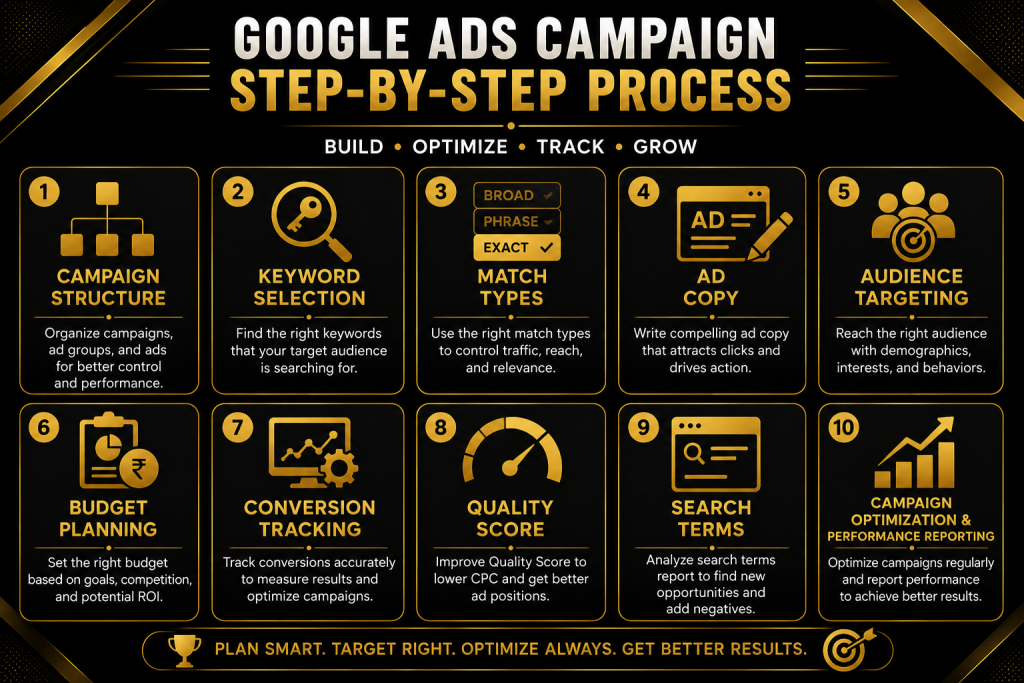
Suppose you learn Google Ads in a classroom. A good practical session should help you understand things such as:
- Campaign structure
- Keyword selection
- Match types
- Ad copy
- Audience targeting
- Budget planning
- Conversion tracking
- Quality Score
- Search terms
- Campaign optimization
- Performance reporting
Similarly, SEO training should involve actual keyword research, website analysis, content optimization, and SEO tools.
When comparing academies, ask:
“Will I get practical experience during the course?”
This question can tell you much more than simply asking about the number of classroom hours.
3. Check Whether the Trainers Have Practical Experience
A trainer can know digital marketing theory very well, but real-world experience can add another level of learning.
Digital marketing platforms keep changing. Google updates its algorithms. Meta changes advertising features. New AI tools appear regularly. Consumer behavior also changes.
A trainer who has worked on real campaigns can explain what happens beyond the textbook.
For example, students can learn from real situations such as:
- Why a campaign is not generating leads
- Why website traffic increased but conversions did not
- Why an ad campaign became expensive
- How to identify poor-quality leads
- How to improve landing page performance
- How to analyze campaign reports
These practical examples make learning easier and more meaningful.
4. Ask About Live Projects
Before joining a course, ask whether students get an opportunity to work on projects.
Projects are important because they help you connect different digital marketing skills.
Imagine working on a small business project.
You may need to:
- Understand the business
- Identify its target audience
- Research competitors
- Find keywords
- Create content
- Optimize the website
- Plan social media content
- Create an advertising campaign
- Track results
- Prepare a performance report
This kind of project teaches you how different areas of digital marketing work together.
It also gives you something valuable to discuss during interviews.
5. Don’t Choose an Academy Only Because of Placement Claims
Placement assistance is useful, especially for freshers. But students should look beyond placement advertisements.
Before believing a placement claim, ask specific questions:
- What type of companies recruit students?
- What job roles are offered?
- Is the placement assistance genuine?
- Are interviews conducted with real companies?
- Does the academy help with resume preparation?
- Are mock interviews provided?
- Does the academy help students build portfolios?
- What happens if a student does not get selected immediately?
A good academy should focus on making students employable rather than simply promising a job.
Remember:
A certificate may show that you completed a course. Your skills and practical knowledge help you perform in the interview.
6. Check Whether the Academy Teaches Current Digital Marketing Tools
Digital marketing is closely connected with technology.
Students should get exposure to commonly used tools and platforms wherever relevant to the course.
Some important tools include:
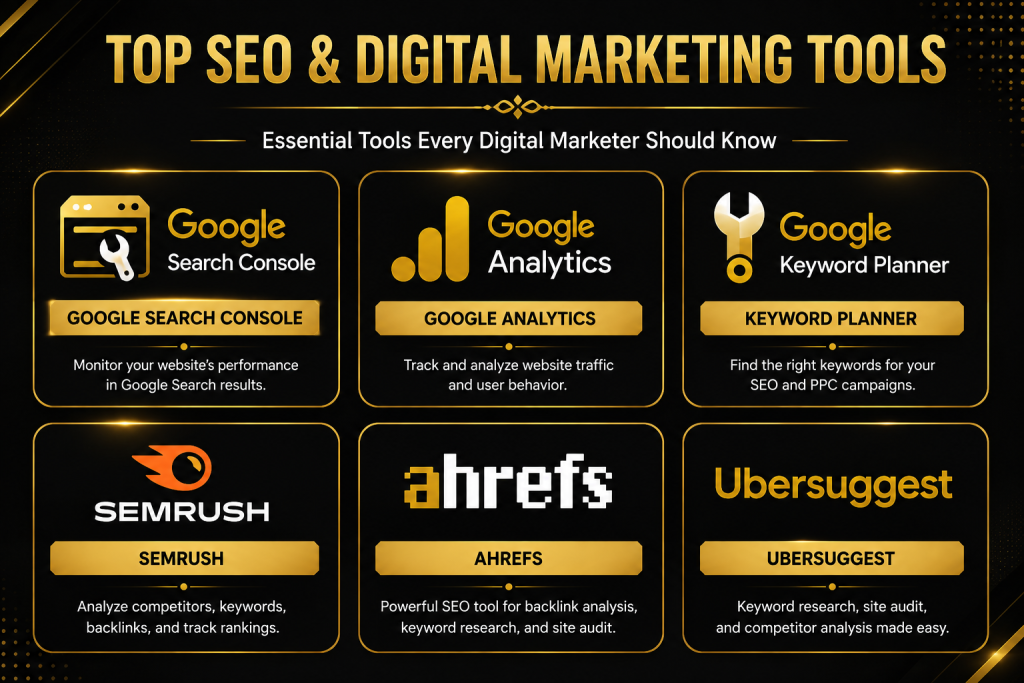
SEO Tools
- Google Search Console
- Google Analytics
- Keyword Planner
- SEMrush
- Ahrefs
- Ubersuggest
Advertising Platforms
- Google Ads
- Meta Ads Manager
- YouTube Ads
Analytics and Tracking
- Google Analytics
- Google Tag Manager
- Looker Studio
Content and AI Tools
- Canva
- ChatGPT
- AI content tools
- AI image and video tools
The exact tools can vary depending on the course, but students should understand how technology supports modern marketing.
7. Ask About AI in Digital Marketing
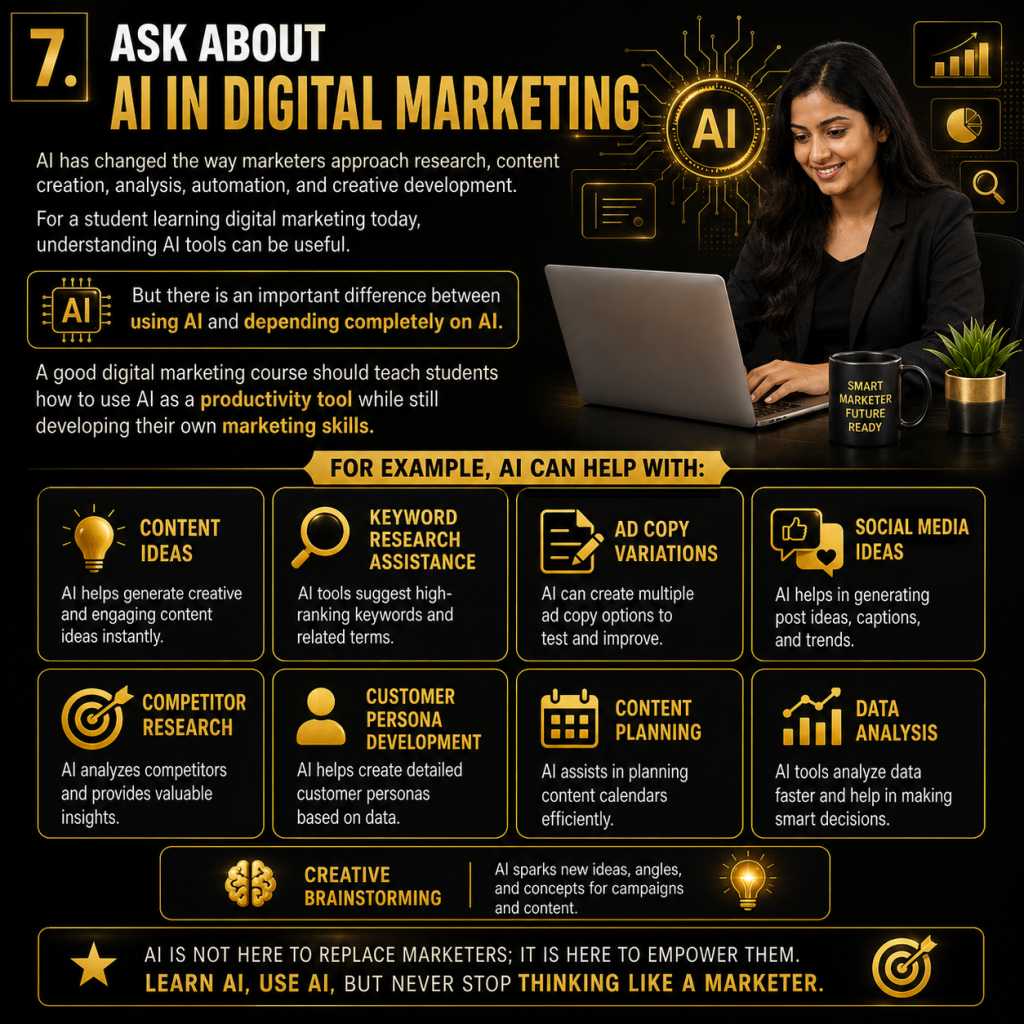
AI has changed the way marketers approach research, content creation, analysis, automation, and creative development.
For a student learning digital marketing today, understanding AI tools can be useful.
But there is an important difference between using AI and depending completely on AI.
A good digital marketing course should teach students how to use AI as a productivity tool while still developing their own marketing skills.
For example, AI can help with:
- Content ideas
- Keyword research assistance
- Ad copy variations
- Social media ideas
- Competitor research
- Customer persona development
- Content planning
- Data analysis
- Creative brainstorming
But marketers still need to understand the audience, business objective, strategy, brand voice, and performance data.
That balance is important for anyone entering digital marketing in 2026.
8. Consider the Learning Environment
The learning environment can have a major impact on your experience.
Before joining an academy, check whether the learning process allows students to ask questions and interact with trainers.
A classroom where students can freely ask questions is often more useful than a system where the trainer simply completes the syllabus.
You can also check:
- Batch size
- Class timings
- Online or offline learning options
- Doubt-clearing sessions
- Practical sessions
- Revision classes
- Course duration
- Trainer accessibility
If you are working or studying at the same time, flexible schedules may also be important.
9. Check Student Reviews Carefully
Online reviews can help you understand other students’ experiences.
However, don’t look only at the star rating.
Read what students actually say.
Look for comments related to:
- Trainer quality
- Practical training
- Course content
- Projects
- Support
- Learning environment
- Career guidance
Try to identify whether reviews are detailed and specific rather than relying only on short comments such as “Best institute” or “Excellent course.”
You can also speak with current or former students if possible.
A genuine conversation with a student can sometimes tell you more than a promotional advertisement.
10. Compare Course Fees With What You Actually Receive
Course fees are important, but choosing the cheapest course is not always the best decision.
Instead of asking:
“Which academy has the lowest fee?”
ask:
“What am I getting for the fee?”
Compare factors such as:
| Factor | What to Check |
|---|---|
| Course duration | Is there enough time for practice? |
| Syllabus | Are important modules included? |
| Trainers | Do they have practical experience? |
| Projects | Are live or practical projects available? |
| Tools | Will you get exposure to industry tools? |
| Career support | Is interview preparation included? |
| Portfolio | Will you create practical work? |
| AI | Are current AI tools covered? |
| Support | Can you ask questions after sessions? |
This gives you a better basis for comparison.
11. Understand Who the Course Is Designed For
Not every digital marketing course is suitable for every person.
A fresher may need basic concepts and career guidance.
A working professional may want advanced performance marketing or SEO skills.
An entrepreneur may be more interested in lead generation and social media marketing.
A career switcher may need a structured program from beginner level.
Therefore, ask:
“Is this course suitable for my current skill level and career goal?”
A good academy should be able to explain what you can realistically learn during the program.
12. Don’t Ignore Portfolio Building
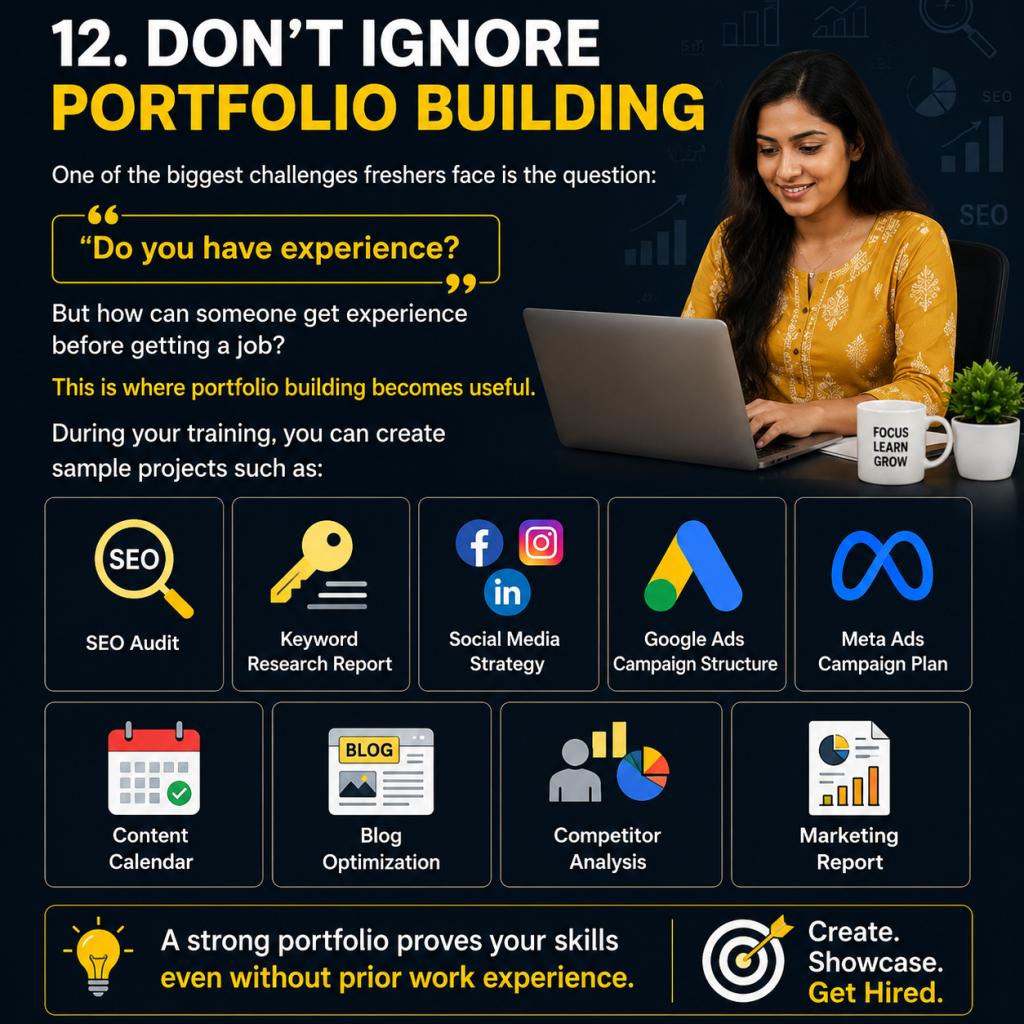
One of the biggest challenges freshers face is the question:
“Do you have experience?”
But how can someone get experience before getting a job?
This is where portfolio building becomes useful.
During your training, you can create sample projects such as:
- SEO audit
- Keyword research report
- Social media strategy
- Google Ads campaign structure
- Meta Ads campaign plan
- Content calendar
- Blog optimization
- Competitor analysis
- Marketing report
These projects can become part of your portfolio.
Instead of simply saying, “I completed a digital marketing course,” you can show what you actually learned and created.
13. Look for Career Guidance and Interview Preparation
Learning the technical skills is one part of becoming job-ready.
Presenting yourself during an interview is another.
A good digital marketing academy can support students with:
- Resume preparation
- LinkedIn profile optimization
- Portfolio development
- Mock interviews
- Digital marketing interview questions
- Communication guidance
- Job search strategies
For freshers, this additional support can make the transition from classroom learning to the job market easier.
Why Consider MBL Digital Marketing Academ in Hyderabad?
For students searching for a digital marketing academy in Hyderabad, MBL Digital Marketing Academy can be considered as one of the options for structured digital marketing learning.
The focus should not simply be on completing lessons. Students should aim to understand how digital marketing works across different channels and how those channels support business goals.
A structured learning approach can help students understand areas such as SEO, Google Ads, Meta Ads, social media marketing, analytics, content marketing, lead generation, and AI-assisted marketing.

For someone starting from the basics, having a learning environment where concepts can be explained step by step can make the process easier.
More importantly, students should use their training period to build practical skills and a portfolio that they can confidently discuss during interviews.
Who Can Join a Digital Marketing Course?
One of the biggest advantages of digital marketing is that it is not limited to one educational background.
A digital marketing course can be useful for:
Students
Students can start developing career-oriented skills before completing their education.
Freshers
Freshers can use digital marketing training to build practical knowledge and improve their job opportunities.
Working Professionals
Professionals can learn digital marketing skills to move into marketing-related roles or add digital skills to their current profile.
Entrepreneurs
Business owners can learn how digital platforms can help generate visibility, enquiries, leads, and customers.
Career Switchers
People looking for a new career path can learn digital marketing from the basics and gradually specialize in areas such as SEO, paid advertising, social media, or analytics.
What Career Options Are Available After Digital Marketing Training?
Digital marketing is not a single job role.
Depending on your interests and skills, you can explore different career paths.
Some common roles include:
- Digital Marketing Executive
- SEO Executive
- SEO Analyst
- Social Media Executive
- Performance Marketing Executive
- Google Ads Specialist
- Meta Ads Specialist
- Content Marketing Executive
- Email Marketing Executive
- Digital Marketing Analyst
- Marketing Automation Specialist
- PPC Executive
As you gain experience, you can move toward specialist, strategist, managerial, or consulting roles.
Questions to Ask Before Joining Any Digital Marketing Academy
Before paying the course fee, prepare a list of questions.
Here are some useful ones:
1. What topics are covered in the syllabus?
2. How much practical training is included?
3. Will I work on projects?
4. Who will train me?
5. What tools will I learn?
6. Is AI included in the curriculum?
7. Will I get career guidance?
8. Is interview preparation provided?
9. Will I build a portfolio during the course?
10. What support is available after completing the course?
Don’t hesitate to ask these questions. You are investing your time and money, so you should understand exactly what you are getting.
A Simple Checklist for Choosing a Digital Marketing Academy
Before making your final decision, use this checklist:
☑ Updated syllabus
☑ Experienced trainers
☑ Practical assignments
☑ Live or realistic projects
☑ Industry-relevant tools
☑ SEO training
☑ Google Ads training
☑ Meta Ads training
☑ Analytics and tracking
☑ Social media marketing
☑ Content marketing
☑ AI tools
☑ Portfolio development
☑ Resume guidance
☑ Interview preparation
☑ Career support
☑ Transparent course fees
☑ Positive student feedback
The more of these boxes an academy can genuinely tick, the stronger your choice is likely to be.
Final Thoughts
Choosing the best digital marketing academy in Hyderabad is not about finding the institute with the biggest advertisement or the lowest course fee.
It is about finding a learning environment where you can understand digital marketing, practice the skills, work on projects, use relevant tools, build a portfolio, and prepare yourself for real career opportunities.
Before joining, compare the syllabus, trainers, practical sessions, projects, tools, student reviews, career support, and overall learning experience.
If you are considering MBL Digital Marketing Academy, take the time to understand the course structure, practical training, projects, and career support before making your decision.
Most importantly, remember that joining an academy is only the beginning.
Your progress will depend on how consistently you practice, experiment, analyze campaigns, learn from mistakes, and keep yourself updated with the digital marketing industry.
The right academy can provide the direction. Your practical effort turns that learning into a career.
Frequently Asked Questions
1. Which is the best digital marketing academy in Hyderabad?
The best academy depends on your learning requirements, budget, career goal, course syllabus, practical training, trainer experience, projects, and career support. Compare these factors before choosing an institute.
2. Is digital marketing a good career for freshers?
Yes. Digital marketing offers multiple entry-level career paths, including SEO, social media, content marketing, paid advertising, and digital marketing executive roles. Practical skills and a strong portfolio can help freshers stand out.
3. How long does it take to learn digital marketing?
The duration depends on the course structure and your learning pace. A structured course can help you understand the fundamentals, while consistent practice is necessary to become confident with real-world campaigns.
4. Do I need a technical background to learn digital marketing?
No. Most digital marketing skills can be learned without programming knowledge. Basic computer skills, analytical thinking, communication, creativity, and a willingness to learn are more important for beginners.
5. What should I learn first in digital marketing?
Start with digital marketing fundamentals and then build knowledge in areas such as SEO, social media marketing, Google Ads, Meta Ads, content marketing, analytics, and lead generation.
6. Is certification enough to get a digital marketing job?
Certification can demonstrate that you completed training, but employers generally also look for practical knowledge. Projects, portfolios, tool knowledge, communication, and the ability to understand marketing objectives can strengthen your profile.
7. Should I choose online or offline digital marketing training?
Both can work. Choose based on your learning style, schedule, trainer interaction, practical sessions, and support. If you learn better through direct interaction, offline classroom training may be useful. If flexibility is important, online learning may be more convenient.
8. Is AI important for digital marketing students in 2026?
AI has become an important part of modern marketing workflows. Students can benefit from learning how to use AI for research, content ideas, analysis, creative development, and productivity while still developing core marketing skills.