A closer, honest look at why hands-on training — not just another certificate — is what actually
gets freshers hired.
If you’ve been job-hunting in digital marketing lately, you’ve probably noticed something: nobody’s
impressed by a certificate anymore. Recruiters want to know if you can actually run a campaign, read
a dashboard, and use AI without it doing all your thinking for you.
That gap is exactly why so many course graduates feel stuck. They’ve got the certificate. They’ve sat
through the modules. But the interview calls just aren’t coming. Usually, it comes down to one thing
— the course stayed on slides and never really turned into something they could do.
MBL Digital Marketing Academy was built around fixing exactly that problem. Instead of treating
marketing as a subject to memorize, the whole program is centered on the tools, the projects, and
the day-to-day problem-solving that a real marketer deals with.
[Image suggestion: Alt text — “Digital marketing student working on live Google Ads and Meta Ads dashboard”]
Why Recruiters Care More About Skills Than Certificates
The bar for entry-level digital marketing hires has gone up, and it keeps rising. Most recruiters now
assume a candidate can already:
● Run a Meta Ads campaign from setup to optimization
● Build a Google Ads campaign without hand-holding
● Improve a website’s search visibility through SEO
● Read and interpret data inside Google Analytics 4
● Set up tracking through Google Tag Manager
● Use AI tools to speed up content and research work
● Explain what a campaign’s numbers actually mean
● Generate and qualify real leadsA certificate might get your resume a second glance. What actually gets you the offer is proof that
you can do the job.
The Mistake Almost Every First-Time Job Seeker Makes
There’s a common belief that finishing a course is basically a guarantee of getting hired. It isn’t —
and most freshers find that out the hard way.
Some of the more common gaps we see in first-time applicants:
● They’ve learned strategies that are already a few years out of date
● They’ve never touched a live, real-world campaign
● They struggle to talk through their own project work in an interview
● They freeze up when actually asked to open a marketing platform
● They don’t have anything to show a hiring manager
An experienced recruiter can tell within a few minutes whether someone has only read about the
tools or has genuinely used them.
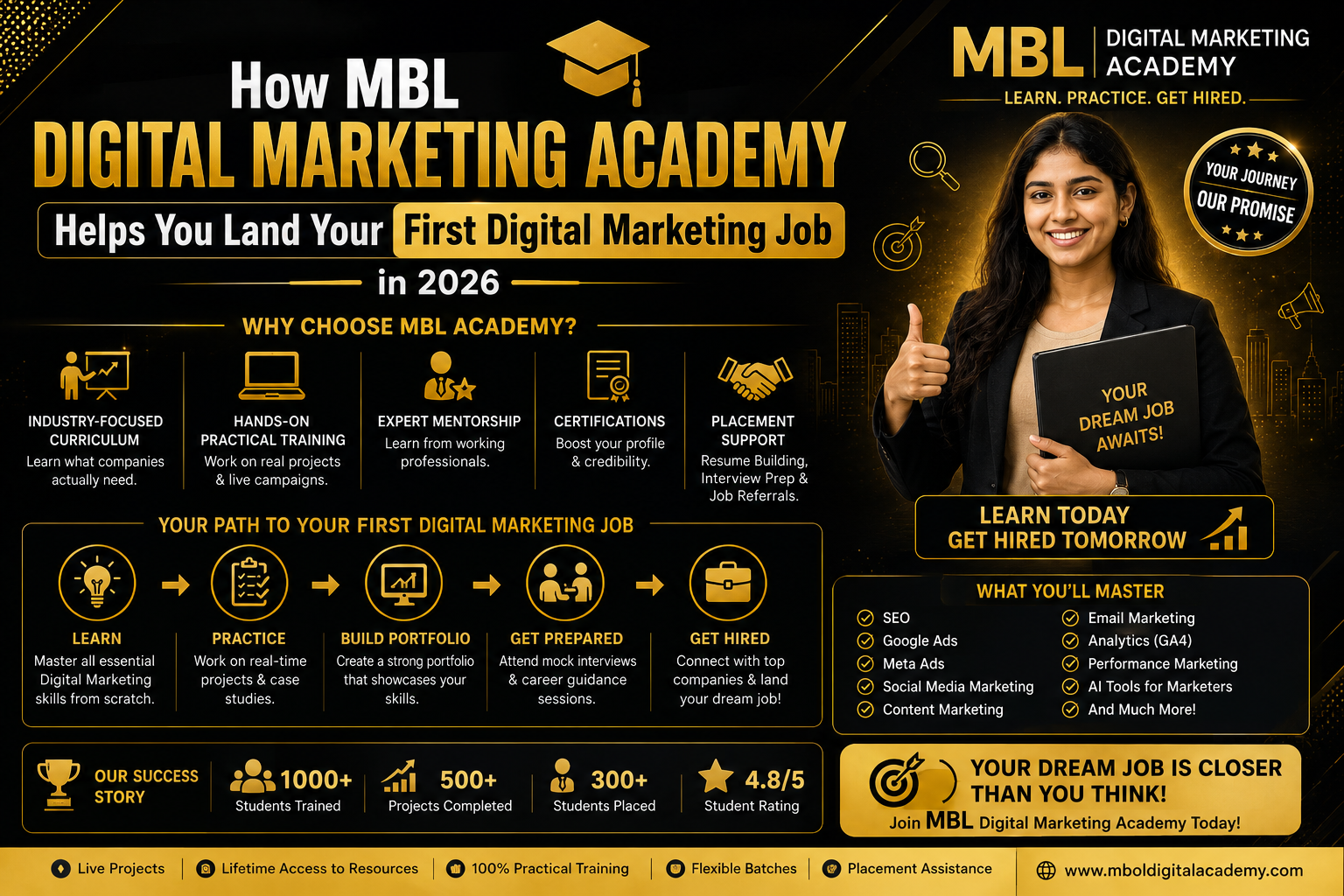
What Makes MBL Digital Marketing Academy Different
The training here is set up to feel less like a classroom and more like a working marketing agency.
Instead of long lecture blocks, students spend most of their time actually inside the platforms
professionals use every single day.
That includes:
● Live, hands-on practical sessions
● Case studies pulled from real businesses
● AI-assisted marketing workflows
● Industry-standard ad platforms and software
● Weekly assignments that are actually graded
● A portfolio that builds up over the course
● Resume writing support
● Mock interview practice
● One-on-one career mentoring
The point was never just to get through a syllabus. It’s to walk out the door ready to be hired.
The Actual Tools Students Get Their Hands On
Confidence in this field comes from repetition — from actually using a tool over and over, not from
reading a slide about it. Here’s what that looks like across each core skill area.
Google Ads
Students build several live campaign types, including:
● Search campaigns
● Performance Max campaigns
● Display campaigns
● YouTube ads
Alongside that, they practice:
● Keyword research
● Writing ad copy
● Planning and allocating budget
● Setting up conversion tracking
● Optimizing live campaigns
Meta Ads (Facebook and Instagram)

Campaigns are built around real objectives such as:
● Lead generation
● Driving website traffic
● Brand awareness
● Engagement
● WhatsApp-based marketing
● Remarketing
Along with the supporting skills behind them:
● Audience research
● Meta Pixel setup
● Events Manager
● Custom audiences
● Lookalike audiences
These are exactly the skills companies expect an entry-level digital marketer to walk in already
knowing.
Search Engine Optimization (SEO)

SEO is still one of the most in-demand skills in the industry. Training covers:
● Keyword research
● On-page SEO
● Technical SEO● Content optimization
● Internal linking
● Local SEO
● Google Search Console
Instead of learning SEO as theory, students apply it to actual live websites and watch the ranking
movement happen.
Google Analytics 4 (GA4)
Every marketer worth hiring needs to be comfortable with data. That means learning how to:
● Track website visitors
● Identify where traffic is actually coming from
● Measure conversions
● Map the customer journey
● Put together a performance report
Marketers who can back a decision with data — instead of a gut feeling — are the ones companies
actively look for.
Google Tag Manager
Students also learn how businesses track user behaviour on a website without editing the site’s code
every time something changes. That covers:
● Event tracking
● Button click tracking
● Form submission tracking
● Conversion tracking
● Pixel installation
Where AI Actually Fits Into the Marketing Workflow

AI stopped being a novelty a while ago — it’s just part of how marketing gets done now. The
academy treats it as a core skill, not an afterthought, teaching students to use it to move faster while
keeping their own strategy and creative judgment in charge.
Tools students get comfortable with include:
● ChatGPT
● Gemini
● Claude
● Canva AI
● Google’s AI tools
● Meta AI
● AI image generators
Applied to real, practical tasks such as :
● Content creation
● Blog writing
● SEO research
● Ad copy generation
● Social media planning
● Email marketing
● Marketing automation
Employers increasingly want marketers who pair AI with strong strategic thinking — not marketers
who let AI do the thinking for them.
Learning by Doing: The Projects That Build Real Confidence
Knowledge only really counts once it’s been applied. Throughout the program, students work on
assignments such as:
● Building a complete Meta Ads campaign
● Running a live Google Ads campaign
● Developing an SEO strategy
● Planning a social media content calendar
● Writing SEO-optimized blog content
● Auditing a website
● Running a competitor analysis
● Presenting a full marketing strategy
Put together, these projects become a portfolio students can actually walk into an interview with and
talk through confidently.
Real Business Case Studies, Not Textbook Scenarios
Rather than working through generic made-up examples, students dig into real marketing challenges
from industries like:
● Healthcare
● Real estate
● Education
● E-commerce
● Restaurants
● Beauty and wellness
● Travel
● Retail
That exposure helps students understand just how differently a strategy needs to be shaped
depending on the industry it’s built for.
Career Support That Doesn’t Stop When the Course Ends
A lot of training providers stop the moment the syllabus is done. At MBL Digital Marketing Academy,
career prep is treated as an ongoing part of the journey, not a final afterthought.
That support includes:
● Building an ATS-friendly resume
● Optimizing a LinkedIn profile
● Building out a portfolio
● Shaping a personal brand
● Practicing mock interviews
● Preparing for HR interview questions
● Preparing for technical interview questions
● Learning the basics of freelancing
● Client communication skills
This kind of preparation makes a real, visible difference in how candidates perform once they’re in
the interview room.
What Recruiters Are Actually Screening For in 2026
Current hiring trends show employers consistently prioritizing candidates who can show:
● Hands-on, practical knowledge
● Comfort using AI tools
● Analytical thinking
● Communication skills
● Marketing strategy
● The ability to optimize a campaign
● A genuine habit of continuous learning
Candidates who can point to real project work almost always stand out more than someone relying
on a certificate alone.
Practical Steps for Landing Your First Role
● Get solid on one skill before jumping to the next
● Build a portfolio around real project work
● Stay current with how AI is being used in marketing
● Learn both Meta Ads and Google Ads
● Build a real understanding of SEO and analytics
● Practice consistently, not just when you feel like it
● Keep working on your communication skills
● Keep your LinkedIn profile active and up to date
● Follow people who are actually working in the industry
● Treat learning as something ongoing, not a one-time box to check
Why Students Choose MBL Digital Marketing Academy
Students choose the academy because the focus is on building an actual career, not just handing out
a completion certificate. The program brings together:
● Practical, hands-on learning
● Live industry projects
● AI-integrated marketing training
● Professional-grade tools
● Career mentorship
● Portfolio building
● Interview preparation
● Placement support
Whether you’re a student, a recent graduate, an entrepreneur, a freelancer, or switching careers
altogether, the goal stays the same: help you become a confident, genuinely employable digital
marketing professional.
Final Thoughts
The marketers who do well from here on out will be the ones who can bring creativity, data,
technology, and AI together in one skill set. A certificate on its own just doesn’t carry that weight
anymore.
Real progress comes from learning by doing — working through genuine business problems and
continuously updating your skills as the field moves.
At MBL Digital Marketing Academy, the goal is to take students from beginners to industry-ready
professionals. If building a career in digital marketing is where you’re headed, start with the skills
companies are actually hiring for today, and stay ready for what the industry will expect tomorrow.
Frequently Asked Questions
1. Is digital marketing still a good career choice in 2026?
Yes. As businesses keep pouring investment into their online presence, skilled digital marketers stay
in demand across almost every industry.
2. Do I need to know how to code to get into digital marketing?
No. A little technical comfort helps, but coding isn’t a requirement for most digital marketing roles.
3. Which digital marketing skills are most in demand right now?
SEO, Google Ads, Meta Ads, GA4, Google Tag Manager, content marketing, social media
marketing, email marketing, and AI-powered marketing tools.
4. Can a complete beginner land a digital marketing job?
Yes. Practical skills, a solid portfolio, and real interview preparation can help freshers land their first
role.
5. Why choose MBL Digital Marketing Academy?
Because the training is built around practical work, industry-standard tools, AI integration, live
projects, career mentoring, interview preparation, and placement support — all aimed at making
students genuinely job-ready.