Digital marketing looks exciting from the outside. You see brands running Instagram campaigns, businesses appearing on Google, creators growing on YouTube, and companies generating leads through online advertising. Naturally, many students start thinking, “I should learn digital marketing too.”
But learning digital marketing is not simply about watching videos, completing a course, or collecting certificates.It is a practical field that requires regular learning, experimentation, analysis, and patience.
Many students join a digital marketing course in Hyderabad with enthusiasm but make small mistakes during their learning journey. These mistakes can slow down their progress and sometimes make them feel that digital marketing is difficult.
The good news is that most of these mistakes can be avoided.
If you are planning to learn digital marketing or are currently pursuing a course at an academy such as MBL Digital Marketing Academy, understanding these common mistakes can help you make better use of your training and become more confident with your skills.
Let’s look at the ten mistakes students should avoid.
1. Learning Only the Theory
One of the most common mistakes beginners make is focusing too much on theory.
Students may remember definitions such as:
- What is SEO?
- What is PPC?
- What is social media marketing?
- What is CTR?
- What is conversion rate?
- What is keyword research?
Knowing these terms is useful, but it is only the beginning.
Digital marketing becomes easier when you actually perform the work.
For example, instead of only learning what keyword research means, try researching keywords for a real business. Instead of only reading about Google Ads, understand how a campaign is structured. Instead of memorizing SEO concepts, analyze a website and identify areas that can be improved.
Theory gives you knowledge. Practice develops your skill.
This is why practical learning should be an important part of any digital marketing course.
2. Trying to Learn Everything at Once
Digital marketing is a broad field.
There is SEO, Google Ads, Meta Ads, social media marketing, content marketing, email marketing, analytics, affiliate marketing, influencer marketing, YouTube marketing, conversion optimization, marketing automation, and many other areas.
On top of that, there are hundreds of tools available.
A beginner may try to learn everything at the same time.
This usually creates confusion.
Instead, start with the fundamentals and gradually build your skills.
For example, you could follow a learning path such as:
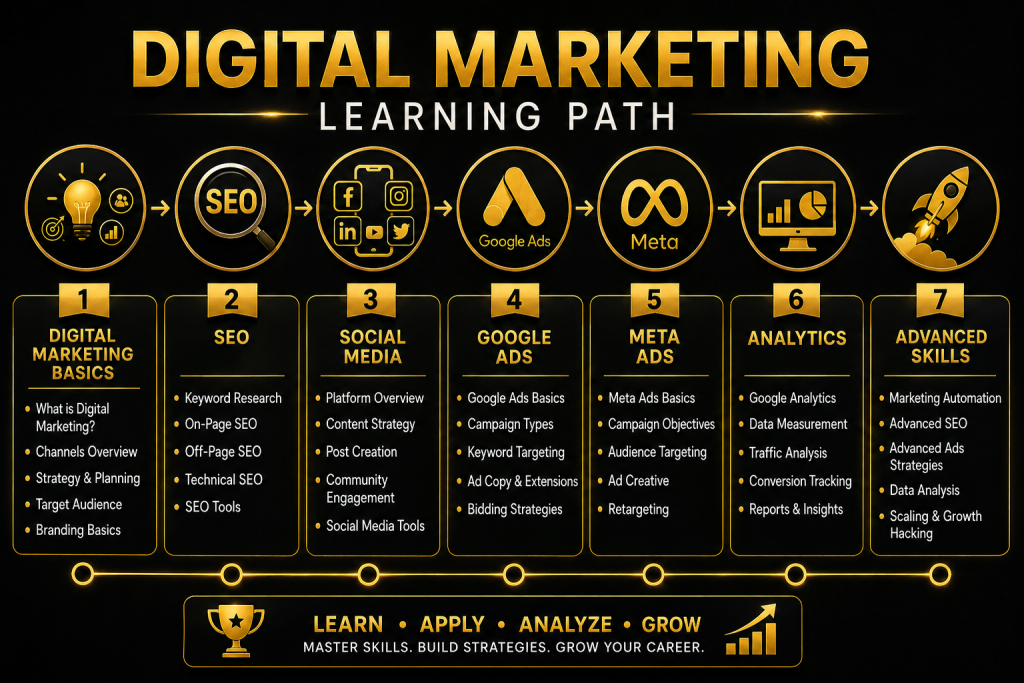
Digital Marketing Basics → SEO → Social Media → Google Ads → Meta Ads → Analytics → Advanced Skills
Once you understand the fundamentals, it becomes much easier to explore specialized areas.
You don’t have to become an expert in every digital marketing channel immediately.
3. Depending Completely on AI Tools
AI has become a useful part of digital marketing.
Students can use AI tools to generate ideas, organize research, create content drafts, brainstorm advertisements, analyze information, and improve productivity.
However, there is a difference between using AI intelligently and depending completely on AI.
Some students copy AI-generated content without checking whether it makes sense. Others use AI to create ad copy without understanding the target audience or business objective.
This can create weak marketing.
A good digital marketer should know:
- Who the target audience is
- What problem the customer has
- What the business wants to achieve
- What message should be communicated
- Which platform is suitable
- How campaign performance should be measured
AI can support your work, but it should not replace your marketing thinking.
Students learning digital marketing today should focus on developing both marketing skills and AI-assisted productivity skills.
4. Ignoring Analytics and Data
Some students enjoy the creative side of digital marketing but avoid numbers and analytics.
That can become a problem.
Digital marketing is not only about creating attractive posts or writing blogs. You also need to understand whether your work is producing results.
Important metrics may include:
- Website traffic
- Click-through rate
- Cost per click
- Conversion rate
- Cost per lead
- Engagement rate
- Return on ad spend
- Organic traffic
- Keyword rankings
You don’t need to become a data scientist.
But you should be comfortable reading marketing reports and understanding what the numbers are telling you.
For example, if an advertisement receives many clicks but very few leads, the problem may not be the advertisement alone. The landing page, offer, audience, or conversion process could also be responsible.
Data helps marketers move from guessing to making informed decisions.
5. Choosing an Academy Only Based on the Certificate
A certificate can be useful for showing that you completed a course.
But a certificate alone cannot demonstrate your practical ability.
One of the common mistakes students make is choosing a digital marketing academy mainly because it promises certification.
Before joining a digital marketing academy in Hyderabad, students should look at much more than the certificate.
Consider:
- Course syllabus
- Practical training
- Trainer experience
- Projects
- Industry tools
- Assignments
- Portfolio development
- Career guidance
- Interview preparation
- Student support
Imagine two candidates applying for the same job.
One candidate has only a certificate.
The other candidate has a certificate plus SEO audits, social media plans, keyword research reports, advertising campaign examples, and other practical projects.
The second candidate has more evidence of what they can actually do.
So, don’t ask only:
“Will I get a certificate?”
Also ask:
“What will I be able to do after completing the course?”
6. Not Working on Projects
Projects are extremely valuable for digital marketing students.
They allow you to apply multiple skills to a real or realistic business situation.
For example, suppose you work on a project for a local restaurant.
You might need to:
- Understand the restaurant’s target audience
- Research competitors
- Find relevant keywords
- Plan social media content
- Create a content calendar
- Develop a Google Ads strategy
- Create a Meta Ads campaign plan
- Analyze potential customer behavior
- Track important metrics
- Prepare a marketing report
Suddenly, the concepts you learned in class become connected.
Projects also help you build a portfolio.
When an interviewer asks, “What have you worked on?”, you can explain your project instead of simply saying, “I completed a course.”
That makes your conversation much more practical.
7. Ignoring SEO Because It Looks Difficult
Some students avoid SEO because it appears technical or takes time to show results.
SEO does require patience, but it is one of the important areas of digital marketing.
Students should understand the basic relationship between:
Keywords → Search Intent → Content → Website Optimization → Rankings → Organic Traffic
SEO also teaches you how people search for information online.
Important areas include:
- Keyword research
- Search intent
- On-page SEO
- Technical SEO basics
- Content optimization
- Internal linking
- Backlinks
- Search Console
- Website performance
- SEO reporting
You don’t need to master everything immediately.
Start with the basics and practice regularly.
8. Learning Ads Without Understanding the Customer
Another common mistake is jumping directly into Google Ads or Meta Ads without understanding the audience.
Advertising platforms provide many targeting options, but targeting options alone don’t create successful campaigns.
Before creating an advertisement, ask:
Who is the customer?
Then understand:
- What problem are they facing?
- What are they looking for?
- What motivates them?
- What objections might they have?
- What offer can help them?
- What action do you want them to take?
For example, an advertisement for a digital marketing course should not communicate the same message to a college student and a business owner.
Their needs are different.
A student may care about career opportunities and practical skills.
A business owner may care about leads, sales, and customer acquisition.
Good advertising starts with understanding people, not just selecting targeting options.
9. Not Building a Personal Portfolio
Many students wait until they get a job before creating a portfolio.
That is a mistake.
You can start building a portfolio while you are learning.
Your portfolio can include:
SEO Projects
- Keyword research
- Website audit
- On-page optimization
- Competitor analysis
Social Media Projects
- Content calendar
- Instagram strategy
- Sample creatives
- Social media campaign ideas
Paid Advertising Projects
- Google Ads campaign structure
- Meta Ads campaign plan
- Sample ad copies
- Audience research
Content Marketing Projects
- Blog articles
- Content strategy
- Landing page copy
- Email campaign examples
You can also create a simple personal website or professional profile where you showcase your work.
A portfolio gives employers something concrete to evaluate.
10. Stopping Learning After the Course Ends
This may be the biggest mistake of all.
Digital marketing keeps changing.
Search algorithms evolve. Advertising platforms introduce new features. Consumer behavior changes. New tools appear. AI continues to influence marketing workflows.
Therefore, completing a digital marketing course should not be treated as the end of learning.
It should be the beginning.
After completing your course, continue to:
- Follow industry updates
- Practice new strategies
- Experiment with campaigns
- Read marketing case studies
- Explore new tools
- Analyze successful brands
- Improve your portfolio
- Take relevant certifications
- Learn from campaign results
You don’t have to spend several hours every day.
Even consistent learning for a short period can make a difference over time.
How MBL Digital Marketing Academy Can Help Students Build Practical Skills

For students looking for a digital marketing academy in Hyderabad, structured learning can make the process easier, especially when starting from the basics.
At MBL Digital Marketing Academy, students can use their learning journey to understand different areas of digital marketing and gradually develop practical skills.
The important objective should not simply be completing the syllabus.
Students should focus on understanding how marketing channels work together.
For example, SEO can help bring organic traffic, social media can help build awareness and engagement, Google Ads and Meta Ads can support paid reach and lead generation, while analytics can help measure what is working.
When students understand this complete journey, digital marketing becomes much more than a collection of separate topics.
It becomes a business-focused skill.
A Better Learning Approach for Digital Marketing Students
Instead of learning digital marketing passively, try using a simple approach:
Learn
Understand the concept first.
Practice
Apply the concept to a real or sample business.
Analyze
Look at the results and identify what worked and what didn’t.
Improve
Make changes based on your observations.
Document
Add useful projects and learnings to your portfolio.
This cycle can help students become more confident.
For example:
Learn SEO → Perform a website audit → Identify issues → Optimize content → Monitor results → Add the project to your portfolio.
The same approach can be applied to social media, paid advertising, content marketing, and analytics.
What Should Students Focus on During a Digital Marketing Course?
If you are currently learning digital marketing, don’t worry about becoming perfect immediately.
Focus on building a strong foundation.
First: Understand Marketing
Learn about customers, audiences, branding, funnels, and business objectives.
Second: Learn the Major Channels
Understand SEO, social media, Google Ads, Meta Ads, content marketing, and analytics.
Third: Practice With Tools
Get comfortable using relevant marketing platforms and analytics tools.
Fourth: Work on Projects
Create practical examples that demonstrate your skills.
Fifth: Build Your Portfolio
Document your best work.
Sixth: Prepare for the Job Market
Work on your resume, LinkedIn profile, interview skills, and communication.
This approach can make your learning journey more organized.
Final Thoughts
Learning digital marketing can open the door to several career opportunities, but joining a course alone will not make someone a successful digital marketer.
Your progress depends heavily on how you use the learning opportunity.
Avoiding common mistakes such as focusing only on theory, depending completely on AI, ignoring analytics, skipping projects, and stopping your learning after certification can make a big difference.
If you are considering a digital marketing course in Hyderabad, look for an academy that provides a balance of concepts, practical learning, projects, tools, and career guidance.
Whether you choose MBL Digital Marketing Academy or another institute, remember one important point:
Don’t learn digital marketing just to complete a course. Learn it to become capable of solving real marketing problems.
The certificate can show that you completed your training.
Your skills, projects, portfolio, and ability to think like a marketer show what you can actually do.
Frequently Asked Questions
1. Is digital marketing difficult for beginners?
Digital marketing can feel overwhelming initially because there are many topics and tools. However, learning the fundamentals step by step and practicing regularly can make the process much easier.
2. Can I learn digital marketing without a technical background?
Yes. You do not need to be a programmer to start learning digital marketing. Basic computer knowledge, communication, creativity, analytical thinking, and willingness to learn are useful starting points.
3. Is practical training important in digital marketing?
Yes. Practical training helps students understand how marketing concepts are applied to real situations. Projects and assignments can also help build a portfolio.
4. Is certification enough to get a digital marketing job?
Certification alone may not be enough. Employers can also look at practical skills, projects, communication, tool knowledge, analytical ability, and portfolio work.
5. Should digital marketing students learn AI?
Yes. Understanding how to use AI tools responsibly can improve productivity. However, students should develop core marketing knowledge rather than depending entirely on AI-generated outputs.
6. What skills should a digital marketing fresher learn?
A fresher can start with digital marketing fundamentals, SEO, social media marketing, Google Ads, Meta Ads, content marketing, analytics, keyword research, and basic reporting.
7. How can students get experience before getting a job?
Students can work on sample projects, internships, freelance assignments, personal websites, mock campaigns, and projects provided during their training.
8. Why is portfolio building important?
A portfolio gives employers practical evidence of your skills. It allows you to demonstrate what you have worked on rather than relying only on your resume or certificate.
9. How should I choose a digital marketing academy in Hyderabad?
Compare the syllabus, trainers, practical sessions, projects, tools, student reviews, career support, portfolio development, course duration, and overall learning experience before making a decision.
10. What is the biggest mistake digital marketing students make?
One of the biggest mistakes is learning passively. Students who only watch classes and memorize concepts may struggle to apply their knowledge. Regular practice and project-based learning are much more valuable.